
ADCET Hackathon 2026 – Season 3 (Sustainable Development Goals (SDGs) – Vikasit Bharat-2047)
ADCET Hackathon 2026 – Season 3 (Sustainable Development Goals (SDGs) – Vikasit Bharat-2047)
ADCET Hackathon 2026 – Season 3
Results
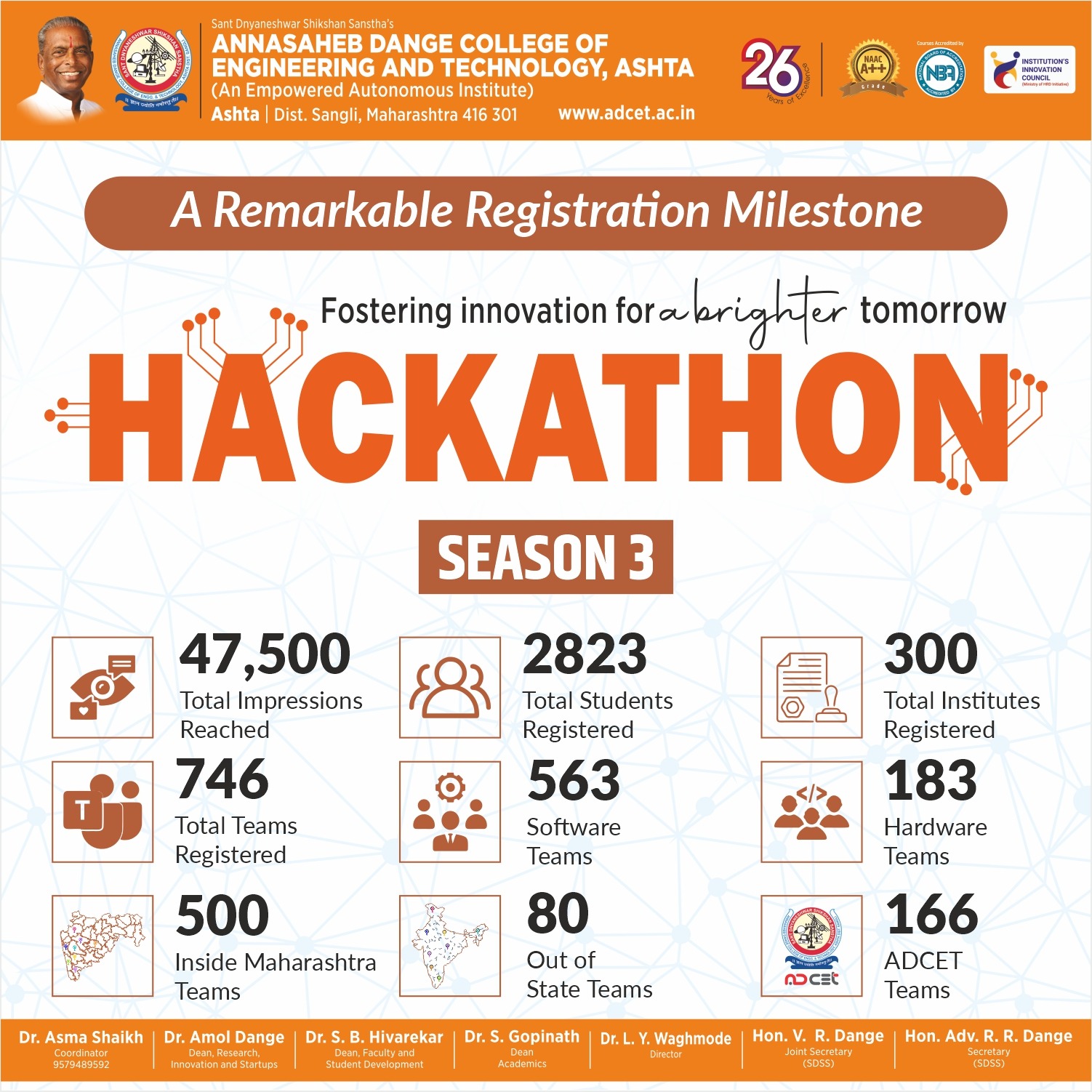
Theme: Sustainable Development Goals (SDGs) – Vikasit Bharat-2047
Hackathon-Rules-and-Guidelines: Click To View
All that you need to know about ADCET Hackathon: Fostering Innovation for a Brighter Tomorrow
For a quarter of a century, Annasaheb Dange College of Engineering and Technology (ADCET), Ashta, has been a beacon of academic excellence and innovation in the field of engineering and technology. Established in 1999, ADCET has consistently strived for excellence, producing generations of skilled professionals and contributing to the advancement of technology and society.
We reflect on the incredible journey that has brought us to this momentous milestone. Our institution has not only provided quality education but has also nurtured creativity, leadership, and a spirit of innovation among our students. It is a testament to the dedication of our faculty, the zeal of our students, and the unwavering support of our alumni and well-wishers.
ADCET Hackathon: Fostering Innovation for a Brighter Tomorrow
ADCET Hackathon Season 3 is a flagship innovation event aimed at nurturing creativity, problem-solving, and entrepreneurial thinking among students. The hackathon is aligned with the United Nations’ Sustainable Development Goals (SDGs) and the Hon’ble Prime Minister of India’s vision of Viksit Bharat-2047, encouraging participants to develop technology-driven solutions for a self-reliant, inclusive, and sustainable India.
Participants are invited to ideate, design, and implement innovative solutions addressing real-world challenges such as sustainable agriculture, clean energy, smart cities, healthcare accessibility, quality education, digital inclusion, environmental protection, women empowerment, and economic growth. The event promotes interdisciplinary collaboration, social responsibility, and the application of emerging technologies like Quantum Computing, Immersive Learning, Generative AI, Digital Twins, Cybersecurity and Blockchain Technology, ARVR, Internet of Things(IoT), Data Analytics, Green Technologies, Smart Agriculture and Food Processing,
ADCET Hackathon Season 3 serves as a platform to transform ideas into impactful solutions, fostering innovation that contributes to national development goals and a sustainable future for India. This hackathon, set to take place on 12th -14th March 2026, is a platform for budding tech enthusiasts, coders, innovators and budding engineers of all disciplines to come together, collaborate, and tackle real-world challenges through the lens of technology.
Sponsors



Round 1
- Date: 7th January 2026 to 5th February 2026 – (Online Mode).
- Idea Submission: Registered teams need to submit an abstract of their project based on one of the given themes. All idea submissions shall be in the format provided on the unstop platform.
Final Round
- Date: 12th, 13th and 14th March 2026 (Offline – Mode)
- 12th & 13th March 2026: (Software Track)
- 12th, 13th, 14th March 2026: (Hardware Track)
- Implementation Round: This will be an offline implementation round, which will be held at Annasaheb Dange College of Engineering and Technology Ashta, Taluka Walwa, District Sangli, Maharashtra Pin – 416301.
ADCET Hackathon Season- 03 Themes – Prizes Worth – 2,00,000/- Lakh
Software Section
| Sr. No. | Theme Category | Theme Description |
|---|---|---|
| 1 | Generative AI & Autonomous Systems | Develop intelligent software systems that can generate content, make decisions, and operate autonomously with minimal human intervention. |
| 2 | Quantum Computing Applications (Software Perspective) | Build software applications, simulators, or hybrid models that demonstrate real-world problem solving using quantum or quantum-inspired computing. |
| 3 | Digital Twins for Industry & Infrastructure | Create virtual replicas of physical systems to monitor, simulate, optimize, and predict performance of industrial or infrastructure assets. |
| 4 | Digital Governance & e-Public Services | Develop digital platforms that enhance government service delivery, citizen engagement, transparency, and administrative efficiency |
| 5 | EdTech 5.0 – Personalized & Immersive Learning | Propose technology-driven learning solutions that adapt to individual learners using AI, analytics, and immersive technologies. |
| 6 | GameTech & Serious Games for Impact | Build games or interactive simulations aimed at education, training, awareness, and social or behavioural impact |
| 7 | System Smart Supply Chain & Logistics Intelligence | Create data-driven software solutions to optimize logistics, forecasting, traceability, and supply chain efficiency |
| 8 | AR/VR Solutions | Develop immersive augmented or virtual reality applications for education, training, healthcare, industry, or social impact. |
| 9 | Cyber Security | Design and develop a comprehensive and extensible e-application fuzzing framework that automates the discovery and security testing of key web application components. |
| 10 | Blockchain Technology | Develop a secure, technology-enabled digital platform for creating, managing, and enforcing assured contractual agreements among stakeholders across diverse sectors. |
Software Edition Prizes- Rs. 1,00,000/- Lakh
- Winner: Rs. 50000/-
- Runner Up: Rs 30000/-
- 2nd Runner Up: Rs 20000/-
Hardware Section
| Sr. No. | Theme Category | Theme Description |
|---|---|---|
| 1 | Smart Resource Optimization System | Design a hardware-based system to monitor and optimize the usage of energy, water, materials, or fuel in industrial, institutional, or domestic applications. |
| 2 | Affordable Automation for Small-Scale Industries | Develop a low-cost automated or semi-automated hardware solution to improve productivity, quality, or safety in small-scale or cottage industries. |
| 3 | Smart Safety and Monitoring Device | Create a hardware solution that enhances safety, security, or hazard detection in workplaces, laboratories, construction sites, or public environments. |
| 4 | Sustainable and Green Technology Solution | Design an eco-friendly hardware prototype focusing on renewable energy, waste reduction, recycling, or environmental monitoring. |
| 5 | Smart Infrastructure and Built Environment | Develop a hardware-enabled system for smart buildings, smart campuses, roads, or infrastructure monitoring |
| 6 | Assistive Technology for Health and Accessibility | Build a hardware-based assistive device supporting healthcare, elderly care, or differently-abled individuals. |
| 7 | Smart Agriculture and Food Processing System | Design a hardware solution to enhance agricultural productivity, food processing efficiency, quality control, or storage. |
| 8 | Predictive Maintenance and Fault Detection | Develop a system capable of detecting faults or predicting maintenance requirements in machines, structures, or equipment. |
| 9 | Smart Mobility and Transportation Solution | Create an innovative hardware model to improve transportation safety, efficiency, or monitoring in ground or aerial systems |
| 10 | Digital-Physical Integration for Business Applications | Design a hardware–software integrated solution for inventory management, logistics, operational tracking, or business process optimization. |
Hardware Edition Prizes- Rs. 1,00,000/- Lakh
- Winner: Rs 50000/-
- Runner Up: Rs 30000/-
- 2nd Runner Up: Rs 20000/-
Additional Details:
Eligibility
- Open to all students of recognized institutions in India (UG / PG / Diploma).
- Team members must be currently enrolled students at respective institutes.
Solutions should align with:
- Innovation
- Scalability
- Feasibility
- Societal Impact
Registration Fees
Registration Fees for first round: Nil
Registration fees for Final Round:
- Software Edition: Rs 200/- Per Student
- Hardware Edition: Rs. 300/- Per Student
Team Details
- Team Size: One Team can consist of 4 - 5 Members (At least one girl student should be a team member from any department).
- Team members can be from same institute or multiple institute, provided that permission letter from all the institutes is required while registering.
Hackathon Rules & Guidelines
1. General Rules
- Each team is allowed to submit only one Idea.
- Participants must strictly follow the Code of Conduct provided by the organizers and Unstop platform.
- Teams are encouraged to develop projects entirely during the hackathon duration.
- For software Edition, if a team uses re-used code or re-submits a project previously submitted in another hackathon, the previous usage and its extent must be clearly disclosed during submission.
- IPR:
- Intellectual Property (IP) of the developed product shall be jointly owned by:
- The developing team and
- The sponsoring industry (if any) and
- The organizers reserve the right to use project details for academic, promotional, or research purposes with due credit.
- Teams must clearly disclose any pre-existing intellectual property (code, libraries, hardware modules, designs, patents, or copyrighted material) used in their project.
- Teams are responsible for protecting their own confidential information.
- Organizers, judges, and mentors are not responsible for maintaining confidentiality of ideas disclosed during presentations or demonstrations.
- Teams should avoid sharing sensitive or patent-pending information unless adequately protected.
- Intellectual Property (IP) of the developed product shall be jointly owned by:
- At least one team member must be present at the team desk at all times during the final round.
2. Project Development Rules
- All projects must be developed from scratch during the hackathon.
- Teams must strictly follow the assigned problem theme.
- A working prototype/ product must be presented at the end of the hackathon.
- Teams may use open-source libraries and tools.
- Any use of pre-built templates must be explicitly disclosed during the final presentation.
- In the event of any changes to the rules or policies, the decision of ADCET shall be final and binding.
3. Hardware & Resource Guidelines
- Participants may use off-the-shelf hardware such as:
- Arduino
- Raspberry Pi
- Sensors, modules, etc.
- Teams must bring their own hardware components; organizers will not provide additional hardware components.
- A basic prototyping kit (breadboards, jumper wires, etc.) may be available in limited quantity.
- Teams must carry their own laptops and computing resources.
- The organizers will provide:
- Casting and testing facilities (Civil Engg.)
- Workshop facilities
- Power supply
- Internet connectivity
4.️Safety Guidelines
- Participants must strictly follow safety protocols while working with hardware.
- Projects involving unsafe practices, including:
- Flammable components
- Hazardous wiring
- Unsafe voltage/current handling will be disqualified immediately.
- Organizer will not be responsible for loss or damage to the participant’s hardware or equipments.
5.️Documentation Requirements for final round
Each team must properly document their project, including:
- Problem Statement
- Approach & Technologies Used
- Challenges Faced and Solutions Implemented
- Hardware design files / block diagrams & product photograph
- Code repository
6.️Submission Guidelines
Final submission must include:
- ✅ A working prototype
- ✅ A 2–3 minute video demonstration of the project
- ✅ A short presentation (PowerPoint or PDF) explaining the project
- ✅ Submission through the designated platform (GitHub repository, Google Drive link, etc.)
7.️Judging Criteria
Projects will be evaluated based on the following criteria:
| Criteria | Weightage |
|---|---|
| 1. Innovation & Creativity | 20% |
| 2. Technical Complexity | 20% |
| 3. Practicality & Real-World Impact | 20% |
| 4. Functionality & Working Prototype | 20% |
| 5. Final Demonstration | 20% |
The decision of the Judging Panel shall be final and binding, and the winners will be selected strictly in accordance with the above-mentioned criteria.
Certification Policy:
- All participants will be provided a certificate of participation.
Contact the organizers:
Coordinator: Dr. Asma A. Shaikh: 9579489592
Co-Coordinator (Software Edition): Dr. Krishnakumar L – : 8124755889
Co-Coordinator (Hardware Edition): Mr. Kiran I. Nargatti: 8600620061
Registration information:
Software Edition Student Coordinator:
- Mr. Harshwardhan Patil: 9699056766
- Mr. Pranav Patil: 9130867073
Hardware Edition Student Coordinator:
- Mr.Rajvardhan R. Patil : 9730548000
- Mr.Nilesh Lohar: 8329293272
Faculty Coordinator for Registration -
- Mr. Pravin More : pbm_cse@adcet.in 9921330873
- Mrs. Amruta Awati : amruta_aids@adcet.in 8329144540
Kindly follow Rules & Regulations updates, Time to Time.